


The Regional Business Succession Problem Nobody Is Talking About

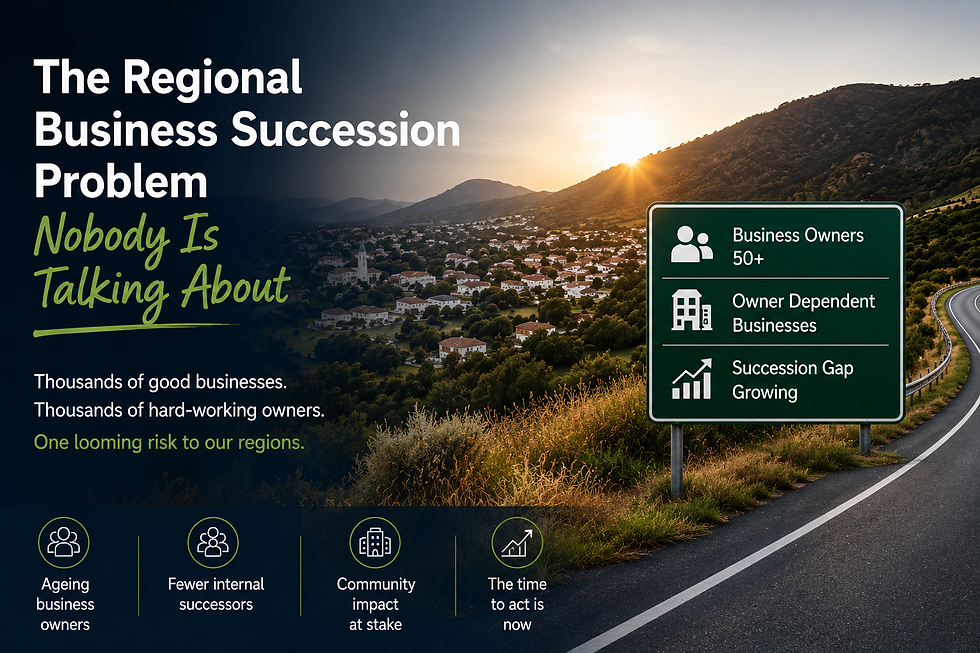
Regional Australia is facing a quiet business transition problem
Across regional Australia, thousands of established business owners are approaching retirement age.
Many have spent decades building businesses that support:
local employment
apprenticeships
suppliers
families
sporting clubs
local economies
regional communities
These businesses are often deeply respected.
But many are also heavily dependent on the owner.
And that creates a problem far bigger than succession alone.
Many Owners Are Not Truly Ready to Step Back
A large number of regional business owners are now reaching the stage where they begin asking:
What does the next chapter look like?
Can I keep doing this pace forever?
What is the business actually worth?
Could the business run without me?
Who would take over?
Is selling even realistic?
The challenge is that many businesses were built operationally around the owner.
The owner still:
holds relationships
manages staff
solves operational problems
approves key decisions
carries pricing knowledge
manages workflow
oversees quality control
The business may look successful externally, but internally it still relies heavily on one person.
That dependence becomes risky as owners age.
This Is Not Just a Personal Problem
The succession challenge in regional Australia affects more than individual owners.
When long-standing businesses close unexpectedly or fail to transition properly, the impact spreads across entire communities.
It affects:
local jobs
suppliers
apprenticeships
service availability
regional economic stability
community confidence
Many regional businesses are not just businesses.
They are part of the local economic infrastructure.
Why Regional Businesses Face Additional Pressure
Regional businesses often operate under conditions metropolitan businesses do not fully experience.
These may include:
difficulty attracting skilled staff
limited access to specialist advisors
stronger dependence on long-term relationships
fewer succession candidates
owner identity tied closely to the business
limited leadership depth
operational knowledge concentrated in one person
At the same time, many regional owners are practical operators who have spent years focused on:
getting jobs done
managing teams
keeping cash flow moving
supporting clients
Long-term strategic planning often gets delayed.
Not because owners lack intelligence or ambition.
Usually because immediate operational demands always take priority.
The “I’ll Deal With It Later” Trap
One of the most common patterns in owner-led businesses is postponing succession and transition thinking.
Owners often say:
“I’m not ready yet.”
“I’ll think about it in a few years.”
“The business still needs me.”
“I’m too busy right now.”
The problem is that transition readiness is not something built quickly.
Strong businesses usually require time to:
strengthen systems
develop leadership
improve visibility
reduce owner dependence
clean up reporting
improve operational consistency
The earlier those improvements begin, the more options become available later.
Why Profit Alone Is Not Enough
Some businesses generate strong revenue but still struggle with transferability.
That is because buyers, successors, and even internal managers are not only assessing profit.
They are assessing:
operational risk
systems maturity
team capability
leadership depth
dependence on the owner
consistency
visibility
A business heavily dependent on one person is harder to:
hand over
scale
finance
transition
sell
That is why many owners become disappointed when they discover their business is worth less than expected — or harder to transfer than they assumed.
Many Owners Don’t Actually Want to Fully Retire
Another misconception is that every owner wants a clean-break exit.
Many do not.
After decades of building something meaningful, owners often still want:
involvement
purpose
income
connection
flexibility
What they usually want is not disappearance.
They want:
less pressure
less dependence
stronger leadership around them
the ability to step back by choice
confidence that the business can function without constant involvement
That is a very different conversation.
A Better Business Creates Better Options
The strongest succession outcomes usually happen when the owner first focuses on building a stronger business.
That means:
improving operational systems
strengthening leadership
reducing owner dependence
improving financial clarity
increasing accountability
building transferability
Once that happens, the owner has more realistic options.
They may choose to:
keep the business
appoint internal leadership
move into a chairman-style role
transition gradually
create a hybrid succession pathway
sell later from strength
The important point is this: A stronger business creates more choice.
The Role of Strategic Advisory
Many regional business owners already have accountants, bookkeepers, bankers, or financial advisors.
But increasingly, owners are looking for broader strategic support around:
operational structure
business performance
leadership capability
succession readiness
owner dependence
implementation
That gap is becoming more visible across regional Australia.
Owners often need more than compliance support.
They need practical strategic guidance to help the business become:
less reliant on them
more stable
more profitable
easier to transition
more valuable over time
The Earlier the Conversation Starts, the Better
The best time to improve transition readiness is not when the owner is already exhausted or urgently trying to exit.
It is earlier.
While the business is still profitable. While there is still energy to strengthen systems. While there is time to build leadership capability. While the owner still has flexibility.
Because succession is rarely a single event.
It is usually the outcome of years spent building a business that can operate successfully without everything depending on one person.
And for many regional businesses, that work may become one of the most important economic and personal transitions of the next decade.


Comments